About
// Bharatpur → Bangalore → Brisbane
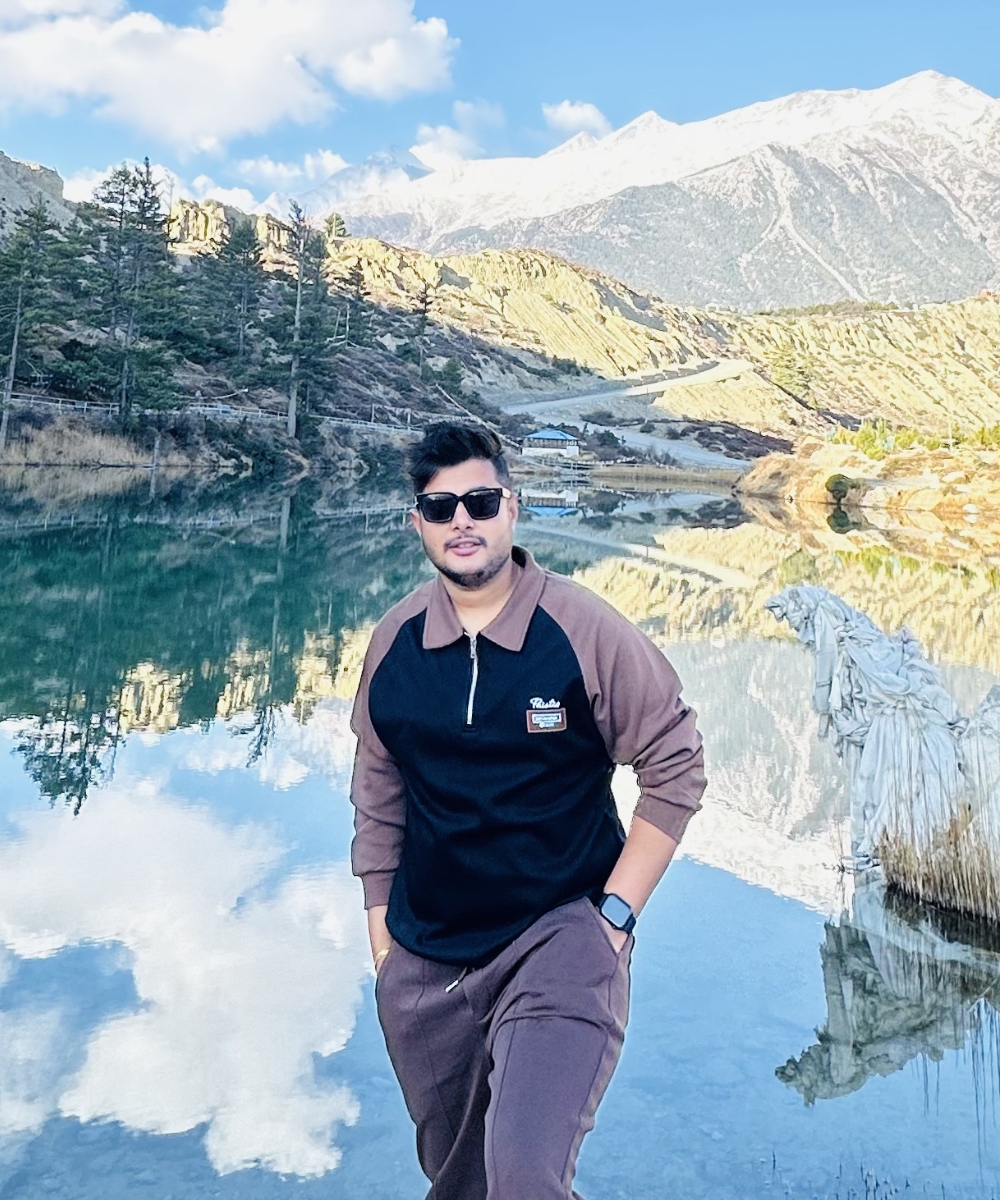
I'm Sulav Raj Bista, a software engineer in Brisbane, AU — though I got here the long way, through Nepal and India. Most of my career has been about owning a hard problem end to end: the vendor management systems that have to work at 2am, the onboarding flow that stops being a support ticket, the alert that fires before a customer notices.
But underneath the senior-engineer resume I'm still the curious kid from Bharatpur who walked to a cyber cafe to play Farmville and came home wanting to know how all of it actually worked. This is the longer, more honest version of that story.
Bharatpur
I grew up in Bharatpur, in Nepal's Chitwan district — sunny, hot, and half-village back then, though it's a proper city now. Home was six of us: my parents, my grandparents, my younger brother, and me, with my father, a government employee, as the main earner. I was a curious kid more than a studious one. Computers arrived in stages - first in 2008, around sixth grade, as trips to the local cyber cafe to play Farmville on this new thing called Facebook; then in 2010, when we got our first computer at home and I could finally poke at the internet on my own terms and break things to see how they worked.
Bangalore, on a scholarship
Engineering took me to India. I sat an entrance exam run by EdCIL - a body under India's Ministry of Education - and placed 34th out of more than 5,000 students, which earned me a full scholarship to Ramaiah Institute of Technology in Bangalore: tuition, accommodation, food, all of it. For a kid from Bharatpur that was an enormous door to walk through. Leaving home that young stung a little, but I've always been single-minded about a goal, and Bangalore wasn't really that far away. It turned out to be some of the best years of my life - a hostel full of friends from Nepal and India, and the kind of memories you only make living away from home for the first time.
How I actually became an engineer
Here's the part most resumes hide: I didn't plan to be a backend engineer at all. The plan was a Master's in the US, so I skipped campus placements entirely to focus on the GRE - and then promptly procrastinated my way to the end of final year with no test score and no job. With the good companies already gone, I grabbed the one offer still on the table, at a company called Odessa, mostly to stop the year going to waste. The job itself wasn't for me, but the first three months - the training cohort were golden, and I made friends there that would shape my career. I am still in touch with some of them.
When a close friend left Odessa for a startup called Fyle, I quit too, telling myself I'd finally study for the GRE. Reality arrived fast: no salary, bills stacking up, real panic. So I taught myself Django, day and night, through the start of 2019 — and that's the moment I fell into the Python world I've lived in ever since. Then that same friend called to rave about Fyle's culture and mention they were hiring. I couldn't help myself: I took the referral, cleared the interviews, and joined.
At Fyle I started on the machine-learning team, on a feature that guessed a receipt's category. It was early and rough - trained on too little data, accuracy embarrassingly low. But the data kept coming, and a team of part-time labellers had hand-labelled thousands of receipts I could trust as ground truth. I retrained the model, reworked the logic, and pushed US-receipt accuracy from around 35% to 95%. (Indian receipts were stubborner - still around 65% when I moved on to the Corporate Cards team.) Fyle was a high-growth startup, which meant I did a bit of everything: bugs, Kubernetes logs at 2am, design docs, microservices at scale. I grew up as an engineer there.
Home during the pandemic
I still had my eyes on the US, but the pandemic closed that door. Stuck, I decided to go back to Nepal for a while and regroup - which is how I ended up spending 14 days quarantining in my own house. Around then, a former Fyle colleague (a fellow Nepali I'd referred there) told me about a founder in Lalitpur building an ad-serving platform who needed a Python engineer to build the engine behind it. The idea was neat: publishers create ad campaigns, websites drop in a small JS snippet, and an ad loads dynamically wherever they place our div — with click and impression tracking, and the business taking a margin on impressions in between. There was one frontend developer building the dashboards in Node and React, and then me, building the serving engine. I was the only backend engineer on it, so I gave myself the title "Lead" - half a joke, half just accurate.
Going remote, and an acquisition
I built the MVP and it worked, but the founder struggled to land real customers — a two-sided ad marketplace is hard to start cold — and the role drifted toward part-time. With no security there and the US plan now behind me, my priorities had shifted; I wanted something stable and remote. Another old Fyle colleague had joined Airbase, a fully-remote fintech in the same world as Fyle but more structured and, honestly, with an even better culture. I got the referral, joined as a mid-level engineer, and was promoted to senior. In late 2024 Airbase was acquired by Paylocity — and that's how I ended up there.
By then I was the longest-tenured engineer on the Vendor Management team. I'd been there when it was 120 people; it was 250 by 2024. The PMs who'd made the early calls had moved on, so when someone needed to know why a legacy system behaved the way it did, the answer was usually me. Being that source of truth - the person other teams escalate to when it matters — is the part of the work I'm proudest of.
Brisbane, a fresh start
In July 2025 my wife and I moved to Brisbane for a genuine fresh start, as she pursues her Master's here. Having my sister already in Brisbane made the landing far softer, and an arrangement to keep working for Paylocity from Australia kept things steady while we found our feet.
I worked with Paylocity through November 2025. Since then I've been doing the real-life things between chapters: building side projects that actually mean something to me, picking up part-time work in aged care to keep the lights on, and grinding LeetCode for the interviews ahead.
In September 2026 I joined Tanda as a Software Engineer — a Brisbane company building workforce management software, and the next team I get to build with.
Journey
Sep 2026 — Present
Software Engineer· Tanda
Building workforce management software — rostering, time and attendance, and payroll — for businesses across Australia and beyond.
Jul 2021 — Mar 2026
Senior Software Engineer· Airbase (acquired by Paylocity)
Technical owner of the Vendor Management module - auth, onboarding, tax compliance, and payments — held to 99.99% success at p95 < 700ms.
Nov 2020 — Jul 2021
Lead Software Developer· Revv Inc
Built and scaled a high-traffic Flask backend on AWS for dynamic ad-publishing portals serving multiple client portals.
Feb 2019 — Oct 2020
Software Development Engineer II· Fyle (acquired by Sage)
Lifted OCR receipt-classification accuracy from 35% to 95% and shipped a secure ACH payment service with micro-deposit verification.
Jun 2018 — Jan 2019
Software Engineer· Odessa Technologies
Delivered client-facing features and resolved production issues on a legacy financial platform within Agile cycles.
How I work
What pulls me to this work is taking something abstract — a vague idea, a messy problem — and turning it into a thing that actually runs. The grind of fighting a hard constraint for hours or days, and then the moment the build goes green and it just works: that payoff never gets old. I'm less fond of where ambitious design meets rigid reality — tight budgets, legacy limitations, shifting timelines — and the unwritten rule that an engineer is never allowed to stop upskilling. (You rarely see accountants doing accounting for fun on the weekend; some days I think a sharp problem-solver with real experience should be allowed to be enough.) But those tensions are the job, and working within them is most of the craft.
- — Boring, reliable systems beat clever, fragile ones.
- — Write the code the next engineer can read at 2am.
- — Ship, measure, then optimise — in that order.
- — Own the problem end to end, not just the ticket.
- — Hold your opinions strongly, but loosely.
What I'm working on in myself
If you scroll my GitHub you'll find abandoned projects — and they're not the only graveyard. Over the years I've started TikTok accounts, YouTube channels, even little online businesses, and walked away from most of them. My wife has my number on this: “You work hard when there's no traction,” she says, “but the moment it starts working, you decide it takes too long and quit.” Consistency is the thing I'm actively working on. (Time management used to be the bigger problem; I've mostly got that one now.) This site is part of the fix — I'd wanted a portfolio for years and kept putting it off. So I built it. It's here. That counts for something.
Outside the terminal
- — Football — the proper kind, not the Aussie sort — though I haven’t played nearly enough since moving to Brisbane.
- — Mobile Legends when I want to switch my brain off, and a side project when I don’t.
- — Travelling, movies, and eating my way through Nepali, Indian, and Italian food.
- — Coffee — black, no sugar. Non-negotiable.
- — Keeping home close: cooking Nepali food, speaking the language with our community, and showing up for every festival.
- — Right now I’m tinkering with MCP and AI agents, sharpening my frontend, and hunting for small Australian tech problems worth open-sourcing a fix for.
Say hello
If you want to swap notes on Python, Django, or keeping systems alive at 2am, I'd genuinely love to hear from you. Email me at bistasulavraj@gmail.com, find me on LinkedIn, or have a look at my resume.